dstoredist
Dstoredist can be used to distribute and/or store protobuf messages generated by dnsdist & recursor. It also has the ability to apply filtering, conversion and sampling to the received protobuf messages.
Destinations to which dstoredist in Userplane can distribute and/or store messages:
- dstoredist
- Kafka
- S3 object storage
- WebSub
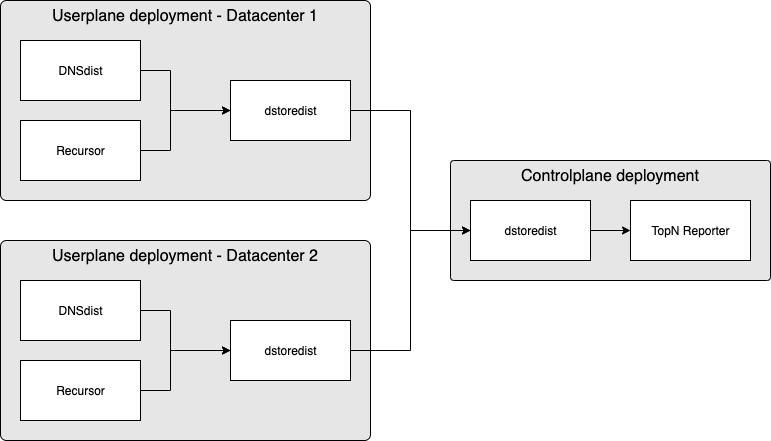
Note: dstoredist inside a Userplane deployment cannot send data directly to other dstore components deployed as part of Controlplane. You will need to have a dstoredist in Userplane configured to send messages to a dstoredist in Controlplane, which can then feed into the other dstore components. Example with TopN Reporter:
Concepts
There are 2 crucial concepts to how dstoredist functions:
- Destination: Location where output messages should be sent or stored
- Routes: Mapping of input filtering rules and destinations
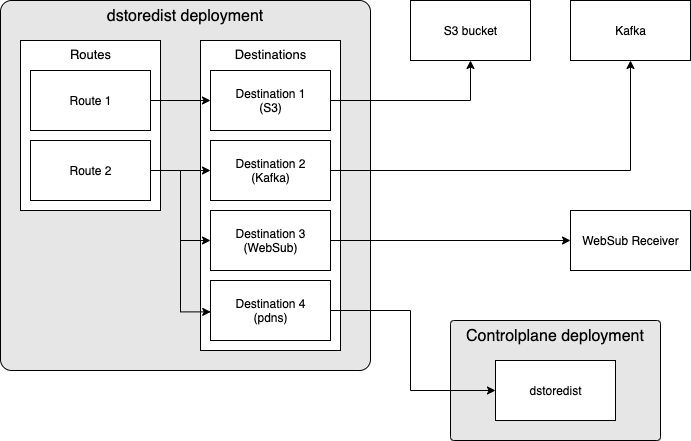
The relationship between these is as follows:
- Routes can specify multiple destinations
- A destination can be specified for multiple routes
- A destination which is not part of any route will not receive any data
A diagram of a potential Userplane dstoredist configuration:
Configuration Reference
Instance Sets
Instances of dstoredist can be defined under the root node dstoredists. Each instance set should be a key-value pair, with:
- key: Name of the instance set
- value: Dictionary holding the configuration of the instance set
In a minimal configuration you will need to have at least 1 destination and 1 route defined. destinations and routes both also require a similar key-value pair, with:
- key: name of the destination/route
- value: Dictionary holding the configuration of the destination/route
A minimal example:
dstoredists:
  mydstoredist:
    < dstoredist configuration >
destinations:
mydestination:
< destination configuration >
routes:
myroute:
destinations:
- mydestination
< route configuration >
Parameters which can be used to configure dstoredist instances for a specific instance set are shown in the below table.
| Parameter | Type | Default | Description |
|---|---|---|---|
affinity |
k8s:Affinity |
pod affinity (Kubernetes docs: Affinity and anti-affinity). If unset, a default anti-affinity is applied using antiAffinityPreset to spread pods across nodes |
|
antiAffinityPreset |
string |
"preferred" |
pod anti affinity preset. Available options: "preferred" "required" |
batchBufferSize |
integer |
1048576 |
Size in bytes of the buffer used to handle message batches internally |
connTimeout |
go:DurationString |
Idle timeout for connections to dstoredist. Only applies if a value is configured explicitly | |
containerSecurityContext |
k8s:SecurityContext |
|
SecurityContext applied to each container |
destinations |
Map of Destination | {} |
Destinations configuration |
hostNetwork |
boolean |
false |
Use host networking for pods |
ipsets |
Map of IPSet | {} |
Sets of IP prefixes which can be used for filtering events |
logFormat |
string |
"text" |
Format of logging. Available options: "text" "json" |
logLevel |
string |
"info" |
Level of logging. Available options: "debug" "info" "warn" "error" |
minReadySeconds |
integer |
Minimum number of seconds for which a newly created pod should be ready without any of its containers crashing, for it to be considered available. Applies Kubernetes defaults when not set, which is 0 seconds | |
nodeSelector |
k8s:NodeSelector |
{} |
Kubernetes pod nodeSelector |
podAnnotations |
k8s:Annotations |
{} |
Annotations to be added to each pod |
podDisruptionBudget |
k8s:PodDisruptionBudgetSpec |
{} |
Spec of PodDisruptionBudget to be applied to deployment |
podLabels |
k8s:Labels |
{} |
Labels to be added to each pod |
podPreemptionPolicy |
string |
Policy for preempting pods with lower priority | |
podPriorityClassName |
string |
Name of PriorityClass to be assigned to each pod | |
podRuntimeClassName |
string |
Name of RuntimeClass to be assigned to each pod | |
podSchedulerName |
string |
Name of scheduler responsible for dispatching pods | |
podSecurityContext |
k8s:PodSecurityContext |
|
SecurityContext applied to each pod |
podTerminationGracePeriodSeconds |
integer |
Duration after which terminating pods are stopped immediately if they do not exit gracefully | |
progressDeadlineSeconds |
integer |
The maximum time in seconds for a deployment to make progress before it is considered to be failed. Applies Kubernetes defaults when not set, which is 600 seconds | |
resources |
k8s:Resources |
|
Resources allocated to the dstoredist container if resourceDefaults (global) is true |
routes |
Map of Route | {} |
Routes configuration |
service |
Service | |
Service configuration |
serviceLabels |
k8s:Labels |
{} |
Labels to be added to each service |
strategy |
k8s:Strategy |
{} |
Kubernetes Deployment Strategy |
tlsconfig |
TLSConfig | {} |
TLS configuration options |
tolerations |
List of k8s:Tolerations |
[] |
Kubernetes pod Tolerations |
topologySpreadConstraints |
List of k8s:TopologySpreadConstraint |
[] |
Kubernetes pod topology spread constraints |
use_tls |
boolean |
false |
If true, enable TLS for inbound listener. Must be configured using tlsconfig |
Service Configuration
Parameters to configure the service object for this deployment. For example:
dstoredists:
  mydstoredist:
    service:
      type: LoadBalancer
      annotations:
        metallb.universe.tf/address-pool: name_of_pool
| Parameter | Type | Default | Description |
|---|---|---|---|
allocateLoadBalancerNodePorts |
boolean |
true |
If true, services with type LoadBalancer automatically assign NodePorts. Can be set to false if the LoadBalancer provider does not rely on NodePorts |
annotations |
k8s:Annotations |
{} |
Annotations for the service |
clusterIP |
string |
Static cluster IP, must be in the cluster's range of cluster IPs and not in use. Randomly assigned when not specified. | |
clusterIPs |
List of string |
List of static cluster IPs, must be in the cluster's range of cluster IPs and not in use. | |
externalIPs |
List of string |
List of IP addresses for which nodes in the cluster will also accept traffic for this service. These IPs are not managed by Kubernetes and must be user-defined on the cluster's nodes | |
externalTrafficPolicy |
string |
Cluster |
Can be set to Local to let nodes distribute traffic received on one of the externally-facing addresses (NodePort and LoadBalancer) solely to endpoints on the node itself |
healthCheckNodePort |
integer |
For services with type LoadBalancer and externalTrafficPolicy Local you can configure this value to choose a static port for the NodePort which external systems (LoadBalancer provider mainly) can use to determine which node holds endpoints for this service |
|
internalTrafficPolicy |
string |
Cluster |
Can be set to Local to let nodes distribute traffic received on the ClusterIP solely to endpoints on the node itself |
ipv4 |
boolean |
false |
If true, force the Service to include support for IPv4, ignoring globally configured IP Family settings and/or cluster defaults. If ipv4 is set to true and ipv6 remains false, the result will be an ipv4-only SingleStack Service. If both are false, global settings and/or cluster defaults are used. If both are true, a PreferDualStack Service is created |
ipv6 |
boolean |
false |
If true, force the Service to include support for IPv6, ignoring globally configured IP Family settings and/or cluster defaults. If ipv6 is set to true and ipv4 remains false, the result will be an ipv6-only SingleStack Service. If both are false, global settings and/or cluster defaults are used. If both are true, a PreferDualStack Service is created |
labels |
k8s:Labels |
{} |
Labels to be added to the service |
loadBalancerIP |
string |
Deprecated Kubernetes feature, available for backwards compatibility: IP address to attempt to claim for use by this LoadBalancer. Replaced by annotations specific to each LoadBalancer provider |
|
loadBalancerSourceRanges |
List of string |
If supported by the LoadBalancer provider, restrict traffic to this LoadBalancer to these ranges | |
loadBalancerClass |
string |
Used to select a non-default type of LoadBalancer class to ensure the appropriate LoadBalancer provisioner attempt to manage this LoadBalancer service | |
publishNotReadyAddresses |
boolean |
false |
Service is populated with endpoints regardless of readiness state |
sessionAffinity |
string |
None |
Can be set to ClientIP to attempt to maintain session affinity. |
sessionAffinityConfig |
k8s:SessionAffinityConfig |
{} |
Configuration of session affinity |
type |
string |
ClusterIP |
Type of service. Available options: "ClusterIP" "LoadBalancer" "NodePort" |
Listener TLS Config
Parameters to configure TLS options if use_tls is set to true, these should be child attributes of the tlsconfig node. For example:
dstoredists:
  mydstoredist:
    use_tls: true
    tlsconfig:
      certSecret: myTLSSecret
    destinations:
      < destinations >
    routes:
      < routes >
| Parameter | Type | Default | Description |
|---|---|---|---|
cert |
string |
Certificate in PEM format. Use of certSecret is recommended for security reasons |
|
certSecret |
string |
Name of a pre-existing Kubernetes TLS Secret containing the tls.crt and tls.key data items |
|
key |
string |
Key in PEM format. Use of certSecret is recommended for security reasons |
Note: Either certSecret or cert + key is required when use_tls is true
IP Set
Parameters to configure sets of IP prefixes which can be used for filtering. For example:
dstoredists:
  mydstoredist:
    ipsets:
      myset:
        configMap: my-config-map
        configMapKey: ipset.dat
    destinations:
      < destinations >
    routes:
      < routes >
Example of what ConfigMap my-config-map could look like:
apiVersion: v1
kind: ConfigMap
metadata:
  name: my-config-map
data:
  ipset.dat: |
    127.0.0.1/16
    128.243.0.0/16
    # Comments beginning with # are allowed
    fe80::1cc0:3e8c:119f:c2e1/18
The above example will expose an ipset named myset, containing the prefixes stored in ipset.dat inside the configmap named my-config-map.
| Parameter | Type | Required | Default | Description |
|---|---|---|---|---|
configMap |
string |
yes |
Name of a pre-existing Kubernetes configmap holding the IP prefixes | |
configMapKey |
string |
yes |
Name of the item inside configMap which holds the IP prefixes |
|
pollInterval |
go:DurationString |
5s |
Interval between checks performed by dstoredist to see if the IP prefixes need to be reloaded from the mounted configmap |
Destination
Parameters which can be used to configure a dstoredist destination:
| Parameter | Type | Required | Default | Description |
|---|---|---|---|---|
blackhole |
boolean |
false |
If true, all messages to this destination will be discarded | |
burst |
integer |
If a rate is configured, allow bursts of messages up to this size |
||
channel_buf_size |
integer |
100 |
The size of the channel buffer used to send batches to destinations. If the destination is writing very large files, e.g. for s3 storage destinations, which can halt processing of new messages for that destination, it can help to increase the buffer size to avoid dropping batches. Use the dstore_dist_route_remote_drop_total metric as a guide - e.g. if it is regularly greater than 0 (increasing the number of workers can also help here). |
|
rate |
integer |
If configured, maximum number of messages per second to send to the destination. Any messages exceeding this will be discarded. By default all messages will be sent to the destination. |
||
sample |
integer |
1 |
Apply sampling to the protobuf messages. If a higher value X is configured, only 1 out of every X messages will be sent to the destination. |
|
type |
string |
"pdns" |
Type of destination. Available options: "pdns" "kafka" "storage" "websub" See below for more configuration options specific to each destination type. |
Destination: pdns
Additional parameters are available on dstoredist destinations with type: pdns (or no type). These should be attributes of the destination item itself. For example:
dstoredists:
  mydstoredist:
    destinations:
      mydestination:
        type: pdns
        addresses:
          - my.dstoredist.endpoint.local:1234
| Parameter | Type | Required | Default | Description |
|---|---|---|---|---|
addresses |
List of string |
yes |
List of addresses of dstoredist deployments. Should be either IP:port or host:port |
|
connect_timeout |
go:DurationString |
"5s" |
How long to wait before timing out connection attempts | |
distribute |
string |
all |
Distribution algorithm when multiple addresses are configured. Available options: "all" "roundrobin" "sharded" "ordered" |
|
framing |
string |
"16bit" |
How to frame protobuf messages. Available options: "16bit" "32bit" "repeated" |
|
tlsconfig |
TLSConfig | {} |
TLS configuration options | |
use_tls |
boolean |
false |
If true, attempt to connect to the addresses using TLS |
|
write_timeout |
go:DurationString |
"5s" |
How long to wait before timing out write attempts |
Destination: kafka
Additional parameters are available on dstoredist destinations with type: kafka. These should be nested attributes inside a kafka: item of the destination item itself. For example:
dstoredists:
  mydstoredist:
    destinations:
      mydestination:
        type: kafka
        kafka:
          addresses:
            - some.kafka.endpoint:9092
          topic: mytopic
The nested kafka: attribute takes the following parameters:
| Parameter | Type | Required | Default | Description |
|---|---|---|---|---|
addresses |
List of string |
yes |
List of addresses of kafka endpoints. Should be either IP:port or host:port |
|
async |
boolean |
false |
If true, dstoredist writes to Kafka never block and all responses from Kafka are ignored |
|
balancer |
string |
"roundrobin" |
Balancer used to distribute Kafka messages amongst partitions. Available options: "roundrobin" "leastbytes" "fnv-1a" "crc32" "murmur2" |
|
batch_size |
integer |
10000 |
Number of messages which will constitute a batch. dstoredist will wait for new messages until either the batch size is reached, or the batch_timeout is exceeded |
|
batch_timeout |
go:DurationString |
1ms |
Timeout before an incomplete batch is written to Kafka | |
compression |
string |
"" |
Compression codec to use. Available options: "gzip" "snappy" "lz4" "zstd" No compression is performed when empty |
|
exclude_fields |
List of string |
[] |
List of fields to exclude from the output. Only applies when json_encode is set to true. Mutually exclusive with include_fields.List of fields can be found in the dstore documentation |
|
include_fields |
List of string |
[] |
List of fields to keep in the output. Only applies when json_encode is set to true. Mutually exclusive with exclude_fields.List of fields can be found in the dstore documentation |
|
instance_name |
string |
If configured, a header will be added to each Kafka message with this value | ||
json_encode |
boolean |
false |
If true, JSON encode the data before sending to Kafka |
|
max_attempts |
integer |
2 |
Number of times a message will be attempted to send to kafka | |
max_msg_size |
integer |
900000 |
Maximum size of a kafka message (in bytes). Cannot be lower than 65536. |
|
num_workers |
integer |
2 |
Number of concurrent workers that will process protobuf messages and send them to kafka | |
read_timeout |
go:DurationString |
10s |
Timeout for reads from Kafka | |
required_acks |
string |
"one" |
How many acks are required from kafka. Available options: "one" "all" "none" |
|
sasl |
SASLConfig | {} |
Optional SASL configuration for authentication | |
single_msgs |
boolean |
false |
If true, each Kafka message will only contain a single protobuf message |
|
tlsconfig |
TLSConfig | {} |
TLS configuration options | |
topic |
string |
yes |
Name of Kafka topic to send messages to | |
use_tls |
boolean |
false |
If true, attempt to connect to the addresses using TLS |
|
write_timeout |
go:DurationString |
10s |
Timeout for writes to Kafka |
SASL Config
SASL can be configured to provide authentication towards Kafka. For example:
dstoredists:
  mydstoredist:
    destinations:
      mydestination:
        type: kafka
        kafka:
          addresses:
            - some.kafka.endpoint:9092
          topic: mytopic
          sasl:
            type: scram256
            username: my_user
            passwordSecretName: my_password_secret
The sasl: attribute takes the following parameters:
| Parameter | Type | Required | Default | Description |
|---|---|---|---|---|
type |
string |
"plain" |
The type of SASL authentication to use, one of "plain", "scram256" or "scram512" |
|
username |
string |
yes |
The username to use for authentication | |
password |
string |
The password to use for authentication. Will be ignored if passwordSecretName is provided |
||
passwordSecretKey |
string |
password |
Name of the item inside the passwordSecretName Secret holding the password |
|
passwordSecretName |
string |
Name of a Secret object containing a password for the user. Has precedence over password |
Destination: storage
Additional parameters are available on dstoredist destinations with type: storage. These should be nested attributes inside a storage: item of the destination item itself. For example:
dstoredists:
  mydstoredist:
    destinations:
      mydestination:
        type: storage
        storage:
          type: s3
          encoding: json
          options:
            secretName: myS3secret
            endpoint_url: https://my.s3.endpoint
            bucket: myBucket
            region: myRegion
The nested storage: attribute takes the following parameters:
| Parameter | Type | Required | Default | Description |
|---|---|---|---|---|
encoding |
string |
"protobuf" |
Encoding used for the files. Available options: "protobuf" "json" "bind" "parquet" |
|
exclude_fields |
List of string |
[] |
List of fields to exclude from the output. Only applies when encoding is json. Mutually exclusive with include_fields.List of fields can be found in the dstore documentation |
|
file_extension |
string |
If provided, each file stored will have .<file_extension> appended |
||
flush_interval |
go:DurationString |
300s |
Time between consecutive flushes to storage (only if max_size is not reached before this interval) |
|
include_fields |
List of string |
[] |
List of fields to keep in the output. Only applies when encoding is json. Mutually exclusive with exclude_fields.List of fields can be found in the dstore documentation |
|
max_size |
integer |
Maximum size in bytes of the file (before compression). Defaults to dstoredist's toplevel configuration item batchBufferSize. If batchBufferSize is not set the value will be 1048576 |
||
num_workers |
integer |
2 |
Number of concurrent workers that will process protobuf messages and attempt to store them | |
options |
StorageOptions | yes |
Configuration of the storage backend | |
parse_rd |
boolean |
false |
If true, use the value of the RD flags set in the protobuf rather than assuming it's true. Only applies when encoding is bind |
|
request_timeout |
go:DurationString |
5s |
How long to wait before giving up on sending requests to storage | |
type |
string |
"s3" |
Type of storage backend. Available options: "s3" |
|
use_compression |
boolean |
false |
If true, compress files using gzip compression |
Storage Options
For storage with type: s3 the following can be configured under options:
| Parameter | Type | Required | Default | Description |
|---|---|---|---|---|
access_key |
string |
S3 access key. Use of secretName is recommended for security reasons |
||
bucket |
string |
yes |
Name of the S3 bucket | |
endpoint_url |
string |
yes |
Endpoint of the S3 service to connect to | |
region |
string |
"us-east-1" |
Region used when connecting to the S3 endpoint | |
secret_key |
string |
S3 secret key. Use of secretName is recommended for security reasons |
||
secretAccessKey |
string |
"access_key" |
If secretName is specified: name of the item inside the Secret which holds the access key |
|
secretName |
string |
Name of a pre-existing Kubernetes Secret containing a username & password for authentication with Elastic | ||
secretSecretKey |
string |
"secret_key" |
If secretName is specified: name of the item inside the Secret which holds the secret key |
|
tlsconfig |
TLSConfig | {} |
TLS configuration options |
Destination: websub
Additional parameters are available on dstoredist destinations with type: websub. These should be nested attributes inside a websub: item of the destination item itself. For example:
dstoredists:
  mydstoredist:
    destinations:
      mydestination:
        type: websub
        websub:
          oauthBackend: myoauthbackend
          scopes:
            - scope1
            - scope2
          publish_url: https://my.websub.url/
          topic: "mytopic"
          headers:
            X-Custom-Header: foobar
The nested websub: attribute takes the following parameters:
| Parameter | Type | Required | Default | Description |
|---|---|---|---|---|
exclude_fields |
List of string |
[] |
List of fields to exclude from the output. Mutually exclusive with include_fields.List of fields can be found in the dstore documentation |
|
headers |
dictionary |
{} |
Set of key:value pairs to be set as headers on each request |
|
include_fields |
List of string |
[] |
List of fields to keep in the output. Mutually exclusive with exclude_fields.List of fields can be found in the dstore documentation |
|
max_size |
integer |
65536 |
Max size in bytes of the messages field in the JSON sent to the websub server | |
num_workers |
integer |
2 |
Number of concurrent workers to use - add more if performance is an issue | |
oauthBackend |
string |
yes |
Name of a userBackend with type oauth2 and a configured tokenURL (See: User Backends) |
|
oauthScopes |
List of string |
[] |
If specified, which scopes to request from the token endpoint | |
publish_url |
string |
yes |
The URL of the websub endpoint. If the URL path does not end with /webSub/v1/publish then that path will be appended to the URL | |
request_timeout |
go:DurationString |
10s |
The request timeout when sending to the websub endpoint | |
topic |
string |
yes |
"" |
The topic to use when sending to the websub endpoint |
tlsconfig |
TLSConfig | {} |
TLS configuration options |
Destination TLS Config
Parameters to configure TLS options if use_tls is set to true, these should be child attributes of the tlsconfig node. For example with type pdns:
dstoredists:
  mydstoredist:
    destinations:
      mydestination:
        type: pdns
        addresses:
          - my.dstoredist.endpoint.local:1234
        use_tls: true
        tlsconfig:
          insecure_skip_verify: true
With type kafka:
dstoredists:
  mydstoredist:
    destinations:
      mydestination:
        type: kafka
        kafka:
          addresses:
            - my.dstoredist.endpoint.local:1234
          topic: myTopic
          use_tls: true
          tlsconfig:
            insecure_skip_verify: true
With type storage:
dstoredists:
  mydstoredist:
    destinations:
      mydestination:
        type: storage
        storage:
          type: s3
          options:
            endpoint_url: https://my.s3.endpoint
            bucket: myBucket
            tlsconfig:
              insecure_skip_verify: true
With type websub:
dstoredists:
  mydstoredist:
    destinations:
      mydestination:
        type: websub
        websub:
          oauthBackend: myoauthbackend
          scopes:
            - scope1
            - scope2
          publish_url: https://my.websub.url/
          topic: "mytopic"
          tlsconfig:
            insecure_skip_verify: true
| Parameter | Type | Required | Default | Description |
|---|---|---|---|---|
ca |
string |
CA in PEM format to use for validation. Use of caSecret is recommended for security reasons |
||
caSecret |
string |
Name of a pre-existing Kubernetes Secret with a data item named ca.crt containing the CA in PEM format to use for validation |
||
cert |
string |
Certificate in PEM format to use for client certificate validation. Use of clientSecret is recommended for security reasons |
||
clientSecret |
string |
Name of a pre-existing Kubernetes TLS Secret containing the tls.crt and tls.key data items to use if the destination requires client certificate validation |
||
insecure_skip_verify |
boolean |
false |
Skip validation of the storage backend's certificate chain and hostname | |
key |
string |
Key in PEM format to use for client certificate validation. Use of clientSecret is recommended for security reasons |
Route
Parameters which can be used to configure a dstoredist route:
dstoredists:
  mydstoredist:
    destinations:
      mydestination:
        type: pdns
        addresses:
          - another.dstoredist.endpoint.local:1234
    routes:
      myroute:
        destinations:
          - mydestination
| Parameter | Type | Required | Default | Description |
|---|---|---|---|---|
append_tags |
List of string |
[] |
List of tags which will be appended each message for this route | |
destinations |
List of string |
yes |
List of names of destinations, these must have been configured on this dstoredist instance | |
filters |
Map of filters | {} |
Filters as defined by the format described in the dstore documentation for the filters parameter under routes |
Routes with filters can have several levels of nesting in the filters, for example:
dstoredists:
  mydstoredist:
    destinations:
      mydestination:
        type: pdns
        addresses:
          - another.dstoredist.endpoint.local:1234
    routes:
      myroute:
        destinations:
          - mydestination
        filters:
          - is_response: true
          - has_deviceid: true
          - tag: REQUIRED_TAG
          - or:
            - tag: GAMBLING
            - tag: FASHION
          - not:
              and:
                - tag: FOO
                - tag: BAR
Refer to the dstore documentation for more insight into the filter configuration.